INTELLIHEALTHCARE
A structured second opinion, powered by machine learning.
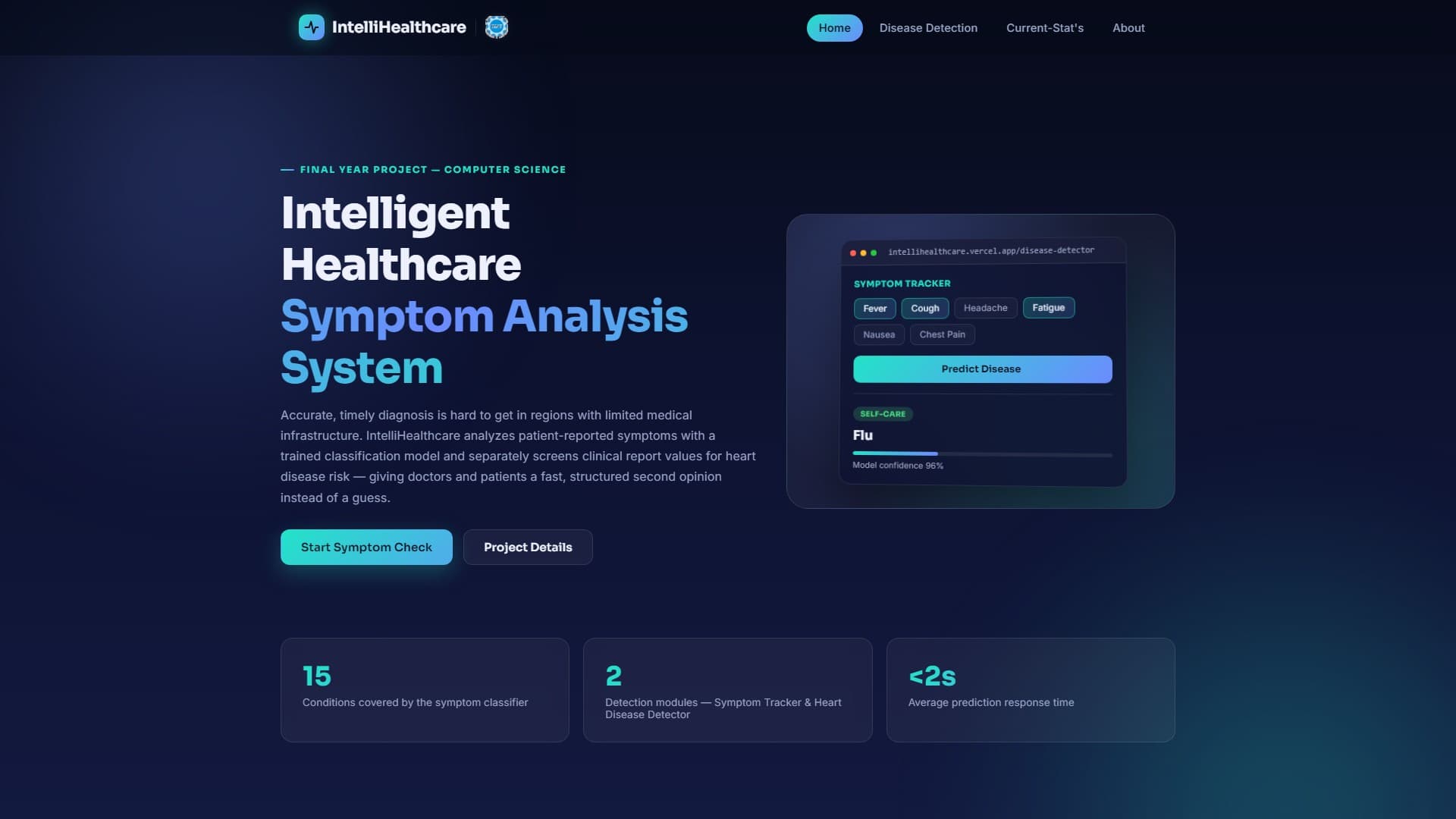
A Final Year Project built with two teammates and a faculty supervisor: a healthcare web app that analyzes patient-reported symptoms with a trained Decision Tree classifier and separately screens clinical report values for heart disease risk with a Random Forest model — giving a fast, structured second opinion in regions where specialists are scarce.
Numbers about the client's business — useful context, not my engineering output.
Numbers I produced — measurable, attributable to the work I did.
From brief to production system.
Accurate, timely diagnosis is a real bottleneck in under-resourced healthcare settings — doctors handling high patient volumes make more errors, and many areas simply lack access to specialists. No existing tool combined a plain-language, doctor-usable interface with a transparent, urgency-ranked machine learning verdict.
Built as a Flask web app with two independent ML modules behind a shared UI: a Decision Tree classifier trained on a 49-symptom, 15-disease dataset for the Symptom Tracker, and a Random Forest classifier trained on 13 clinical inputs (blood pressure, cholesterol, ECG results, etc.) for the Heart Disease Detector. Every prediction returns with an urgency label — emergency, see a doctor, or self-care — so the next step is never ambiguous.
Live at intellihealthcare.vercel.app. The symptom classifier holds ~83% accuracy and the heart-risk model ~80%, both computed on a held-out test split and displayed live on the site's own stats page rather than hardcoded.
The boundaries that shaped the build.
- 01Had to be usable by doctors and patients with no ML background — no raw probabilities, just plain-language guidance
- 02Text-based symptom input only — no assumption of lab equipment or connected medical devices
- 03Student project budget — free-tier hosting only, no paid infrastructure
- 04Browser-only access (Chrome/Firefox/Edge) — no native app requirement
What I chose, and what I gave up.
Custom-built symptom/heart-risk datasets instead of a public Kaggle dataset
A larger, pre-vetted sample size. Won a dataset whose symptom-disease relationships we could design and verify against the report's exact disease list — at the cost of clinical validity, which is why the site is explicit that this is diagnostic assistance, not a certified medical tool.
Decision Tree / Random Forest instead of a neural network
The heavier 'deep learning' pitch. Won a model that's interpretable and fast enough for sub-2-second predictions on free-tier serverless hosting — the right trade for a structured, tabular symptom dataset at this scale.
How it shipped, week by week.
Domain research
Requirements analysis, use cases, and stakeholder mapping for a symptom-analysis tool aimed at resource-limited healthcare settings.
Data + models
Built the symptom/heart-risk datasets and trained the Decision Tree and Random Forest classifiers.
Web app
Flask backend, prediction endpoints, and the full front-end — Symptom Tracker, Heart Detector, stats page, AI assistant.
Testing
Decision-table test cases across multiple symptom combinations, verifying predicted vs. expected disease.
Deploy + polish
Shipped to Vercel, then a full visual pass — typography system, animated background, scroll reveals.
What it does. How it's built.
Features
- Symptom Tracker — searchable 49-symptom picker across 15 supported conditions
- Heart Disease Detector — 13 clinical inputs (BP, cholesterol, ECG, etc.) scored by a Random Forest model
- Urgency-labeled results (emergency / see a doctor / self-care) on every prediction
- Lightweight AI health assistant with an optional live Gemini API connection
- Live model-accuracy stats page — not a fixed number
Architecture
- 01Flask backend serving both the UI (Jinja templates) and JSON prediction endpoints
- 02Two independently trained scikit-learn models pickled and loaded once at boot
- 03Vanilla JS frontend — no framework, kept deliberately light for a serverless deploy
- 04Deployed on Vercel's Python runtime, GitHub-connected for auto-redeploy on push
Annotated excerpts.
@app.route("/predict-symptoms", methods=["POST"])
def predict_symptoms():
    payload = request.get_json(silent=True) or {}
    selected = set(payload.get("symptoms", []))

    if not selected:
        return jsonify({"error": "Please select at least one symptom."}), 400

    input_vector = pd.DataFrame(
        [[1 if s in selected else 0 for s in SYMPTOMS]], columns=SYMPTOMS
    )
    prediction = DISEASE_MODEL.predict(input_vector)[0]

    confidence = None
    if hasattr(DISEASE_MODEL, "predict_proba"):
        proba = DISEASE_MODEL.predict_proba(input_vector)[0]
        confidence = round(float(max(proba)) * 100, 1)

    description, advice, urgency = DISEASE_INFO.get(
        prediction, ("", "Please consult a healthcare professional.", "see-doctor")
    )

    return jsonify({
        "disease": prediction,
        "description": description,
        "advice": advice,
        "urgency": urgency,
        "confidence": confidence,
})def main():
df = pd.read_csv(DATA_PATH)
symptoms = list(df.columns[1:])
diseases = sorted(df["Disease"].unique())
X = df[symptoms]
y = df["Disease"]
X_train, X_test, y_train, y_test = train_test_split(
X, y, test_size=0.2, random_state=42, stratify=y
)
model = DecisionTreeClassifier(max_depth=12, random_state=42)
model.fit(X_train, y_train)
accuracy = accuracy_score(y_test, model.predict(X_test))
with open(MODEL_PATH, "wb") as f:
pickle.dump({
"model": model,
"symptoms": symptoms,
"diseases": diseases,
"accuracy": accuracy,
}, f)Continue browsing
Have a project like this in mind? Let's talk.
Send me a brief and I'll respond within 24 hours.